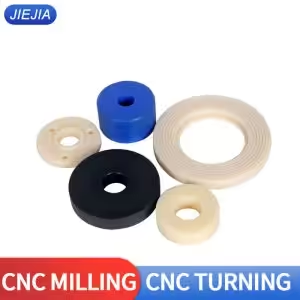
CNC Turning ABS
CNC Turning ABS Service – China Custom CNC Turning ABS Parts Manufacturer & Company
Jiejia has extensive experience in CNC turning ABS parts and other components made from a wide range of materials. Rely on our plastics machining services to get you the highest quality parts at the best prices with the fastest lead times. Our machining shop is equipped with the latest CNC turning machines, allowing us to machine complex parts with intricate structures and tight tolerances. In addition, we offer secondary machining and surface finishing options for machined parts, as well as finished product assembly, ensuring that you experience the best one-stop-shop service at Jiiejia. Feel free to send us your inquiry.
CNC turning characteristics of ABS
ABS (Acrylonitrile Butadiene Styrene Copolymer) is a common engineering plastics, its CNC turning characteristics are as follows:
Cutting performance: ABS has good cutting performance, easy to cut and process. CNC turning can accurately control the movement path of the tool and cutting parameters, making the machining process more stable and efficient.
Self-lubrication: ABS has good self-lubrication, which can reduce the friction between the tool and the tool, reduce the cutting force and tool wear, so as to extend the service life of the tool.
Coefficient of Thermal Expansion: ABS has a low coefficient of thermal expansion, the dimensional stability of the machined parts is good and not easily affected by thermal expansion, ensuring machining accuracy and consistency.
Abrasion resistance: ABS material has good abrasion resistance and can maintain good surface quality after a long time of use.
Chemical resistance: ABS has good resistance to general chemicals and solvents, but may be affected in some special chemical environments.
Good insulating properties: ABS is an excellent insulating material for the manufacture of parts in the electrical and electronic fields.
Plasticity: ABS has good plasticity and can be used to make various shapes of parts by hot compression molding, injection molding and other processes.
Low-temperature resistance: ABS has good low-temperature resistance and still has good toughness and strength at lower temperatures.
Benefits of ABS CNC turning
There are many benefits of ABS CNC turning, including:
Precision machining: CNC turning can accurately control the movement path of the tool and machining parameters, thus realizing high-precision machining and ensuring the accuracy and consistency of part dimensions.
High efficiency: CNC turning enables automated and continuous machining, which can greatly improve productivity and save time and labor costs compared to traditional manual machining.
Stability: CNC turning uses fixed tool paths and cutting parameters, which makes the machining process stable and reliable, and reduces the impact of human factors on machining quality.
Flexibility: CNC turning can manufacture various shapes and sizes of parts according to different design requirements, adapting to different application scenarios.
Repeatability: Since CNC turning uses pre-programmed codes, the same motion trajectory and cutting parameters can be repeated each time machining is performed, ensuring the consistency and repeatability of parts.
Reduced scrap rate: CNC turning reduces scrap rate because the machining process is more stable and controllable, reducing part damage due to factors such as operator error.
Automated production: CNC turning is an important tool for automated production, which can realize large-scale and high-efficiency production and is suitable for mass production.
Versatility: CNC turning can be used to process a variety of different materials, including metals, plastics, composites, etc., and is highly applicable.
Industries where CNC turned ABS parts are used
CNC turning ABS parts are widely used in the following industries:
Electronic and electrical industry: ABS material has good insulating properties and mechanical strength, so it is used in the electronic and electrical fields to manufacture sockets, electrical enclosures, switches, electrical connectors and other parts.
Automotive industry: ABS materials are widely used in the automotive industry to manufacture body parts, interior parts, instrument panels, door handles and other parts.
Mechanical equipment manufacturing: ABS materials are used in the mechanical equipment manufacturing industry to manufacture a variety of mechanical parts, bearings, gears, rails and so on.
Medical equipment: ABS material is used in the field of medical equipment for the manufacture of handles, shells, bases and other parts, due to its good corrosion resistance and easy-to-clean characteristics.
Communication equipment: ABS material is used in the communication equipment industry to manufacture cell phone shells, wireless router shells, communication equipment shells and other parts.
Household appliances: ABS materials are used in the household appliance industry to manufacture vacuum cleaner shells, washing machine parts, refrigerator parts and so on.
Toy manufacturing: ABS material is widely used in toy manufacturing industry due to its safety, environmental protection, easy processing and other characteristics.
ABS CNC turning common problems and solutions
Here are some common problems and corresponding solutions:
Poor chip control: The chips generated during the cutting process of ABS material may accumulate between the tool and the workpiece, affecting the machining quality. The solution is to increase the cutting lubricant, clean up the chips in time and maintain a stable supply of cutting fluid.
Processing temperature is too high: ABS material is easy to cause high temperature, in the CNC turning process is easy to produce processing temperature is too high, may lead to poor surface quality of parts. The solution is to appropriately reduce the cutting speed and feed rate, the use of lubricants to reduce friction heat.
Excessive cutting force: Due to the high hardness of ABS material, it may lead to excessive cutting force, resulting in increased tool wear. The solution is to choose the right cutting tool, use reasonable cutting parameters, control the cutting force within the acceptable range.
Processing surface roughness: ABS material is prone to large cutting force, resulting in processing surface roughness. The solution is to adjust the cutting parameters and use finer cutting tools to improve the quality of the machined surface.
Dimensional instability: Due to the low coefficient of thermal expansion of ABS material, it may lead to dimensional instability during machining. The solution is to control the machining temperature and use appropriate fixtures and jigs to ensure the dimensional stability of the parts.
Cutting vibration: Cutting vibration will lead to poor surface quality of the parts, and even damage to the tool and workpiece. The solution is to choose a rigid tool and fixture, adjust the cutting parameters to reduce cutting vibration.
CNC turning commonly used plastics are as follows:
CNC turning Bakelite
CNC turning FR4
CNC turning nylon
CNC turning PE
CNC turning PEEK
CNC turning POM
CNC turning PP
CNC turning PPS
CNC turning PTFE
CNC turning PVC
CNC turning carbon fiber