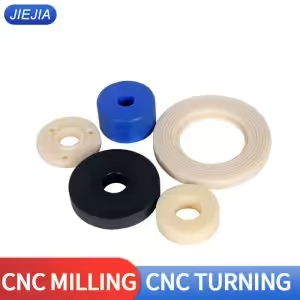
CNC Turning FR4
RF4 CNC Turning Service – China Precision CNC Turning RF4 Parts Manufacturer
Are you looking for high quality and cost effective FR4 CNC turning parts?JiejiaCNC has advanced CNC turning machines and engineers who can handle complex CNC machining of FR4 parts while maintaining high precision, quality accuracy, flexibility and consistency. If you are considering using FR4 material to manufacture the CNC turned products you need, please feel free to request a quote online or contact us for more details and we will be happy to help you with your project.
CNC turning characteristics of FR4
FR4 CNC turning has the following characteristics:
High strength: FR4 composites are reinforced by glass fibers, which have high strength and stiffness, enabling them to maintain a stable structure in the CNC turning process.
Wear resistance: FR4 has high surface hardness and good wear resistance, which can resist the wear of cutting edge tools during CNC turning.
Low Coefficient of Thermal Expansion: FR4 is good for maintaining the dimensional stability of the workpiece and reducing thermal stress during CNC turning due to its low coefficient of thermal expansion.
Electrical insulation: FR4 is an electrically insulating material and can be used to manufacture circuit boards and other parts that require electrical insulation.
Good chemical stability: FR4 has good corrosion resistance to many chemicals and is not easily eroded by chemical media.
Low thermal conductivity: FR4 has low thermal conductivity, which is favorable to reduce the heat-affected area in the CNC turning process.
Easy to process: FR4 CNC turning, its composite structure makes it easy to process, you can choose the appropriate cutting parameters and tools to get good processing results.
Benefits of FR4 CNC turning
FR4 CNC turning has the following benefits:
High strength and rigidity: FR4 composite material is reinforced by glass fibers, which has high strength and rigidity, and can maintain a stable structure during CNC turning to ensure machining accuracy and part quality.
Good wear resistance: FR4 has high surface hardness and good wear resistance, which makes the tool more durable and prolongs tool life during CNC turning.
Electrical insulation: FR4 is an electrically insulating material, suitable for the manufacture of electronic circuit boards and other parts requiring electrical insulation to ensure the normal operation and safety of the circuit board.
Good chemical stability: FR4 has good corrosion resistance to many chemicals and is not easily eroded by chemical media, making it more stable and reliable for use in specific environments.
Low coefficient of thermal expansion: FR4’s low coefficient of thermal expansion is conducive to maintaining the dimensional stability of the workpiece, reducing thermal stress and improving processing accuracy.
Low thermal conductivity: The low thermal conductivity of FR4 is favorable to reduce the heat-affected area and the thermal deformation of the workpiece in the CNC turning process.
Easy to process: The composite structure of FR4 makes it easy to process, and better surface quality and dimensional accuracy can be obtained in the process of CNC turning.
Environmental protection: FR4 is a halogen-free and environmentally friendly material, which does not produce harmful gases in the process of use and meets the requirements of environmental protection.
Industries where CNC turning of FR4 parts is applied
The following are some common industry applications:
Electronic circuit board manufacturing: FR4 is one of the most common circuit board substrate materials, it has excellent electrical insulation and mechanical properties, and can maintain high precision and flatness during the CNC turning process, which is used to manufacture various types of printed circuit boards (PCBs).
Electrical equipment manufacturing: FR4 material’s electrical insulation properties make it an ideal material for manufacturing a variety of electrical equipment, such as relays, switches, sockets, power connectors.
Communication equipment: FR4 CNC turned parts are widely used in communication equipment, such as antennas, signal transmission equipment, network equipment.
Automotive electronics: There are more and more electronic components in modern automobiles, and the stability and durability of FR4 material makes it an important material for automotive electronic parts.
Industrial control equipment: FR4 CNC turned parts are used in industrial control equipment, such as industrial control machine, PLC, inverter, etc.
Medical equipment: FR4 material’s corrosion resistance and stability make it a manufacturing material for some medical equipment.
FR4 CNC turning common problems and solutions
Here are some of these common problems and solutions:
Cutting Edge Tool Wear: Due to the high hardness of FR4, the cutting edge tool may wear out quickly. The solution is to check and replace the cutting edges regularly, use high-quality tool materials, and reasonably select cutting parameters to avoid excessive wear.
Rough cutting surface: The glass fiber reinforced structure of FR4 may cause burrs or fiber stripping on the cutting surface. Solutions include adjusting the cutting speed and feed rate, using appropriate cutting edge tools, increasing cutting lubricants, and cleaning the cutting area regularly.
Thermal deformation: FR4 may be thermally deformed during high-speed cutting, resulting in dimensional instability of the part. Solutions include reducing the cutting speed and depth of cut, lowering the cutting temperature, using coolant for cooling, and using proper clamping to secure the workpiece.
Fiber buildup: The fiber structure of FR4 material may lead to fiber buildup during the cutting process, affecting the machining quality. Solutions include the use of proper cutting edge design, adjustment of cutting parameters, regular cleaning of the cutting area, and selection of appropriate cutting paths.
Dimensional deviation: Due to the low coefficient of thermal expansion of FR4, temperature changes may lead to dimensional deviation of parts. The solution is to control the temperature during the machining process, use a stable machining environment, and adopt appropriate compensation measures.
High precision requirements: For some high-precision parts, FR4 machining may face greater challenges. The solution includes using high-precision CNC machine tools, selecting high-quality cutting tools and fixtures, and strictly controlling the parameters of the machining process.
CNC turning commonly used plastics are as follows:
CNC turning ABS
CNC turning Bakelite
CNC turning nylon
CNC turning PE
CNC turning PEEK
CNC turning POM
CNC turning PP
CNC turning PPS
CNC turning PTFE
CNC turning PVC
CNC turning carbon fiber